FPV Drones and the Winter Olympics: A Turning Point for Sports Broadcasting, and the Drone Industry
FPV Drones and the Winter Olympics: A Turning Point for Sports Broadcasting, and the Drone Industry

The Olympic Winter Games have always been a showcase for human performance at the very edge of what is physically possible. Now, they are also becoming a showcase for what modern drone technology can achieve when innovation, professionalism, and safety come together.
For viewers watching at home, the Winter Games are more visually impressive than ever.
This leap forward is not solely the result of traditional camera placements along courses or refined production techniques, but increasingly thanks to FPV (first-person view) drones.
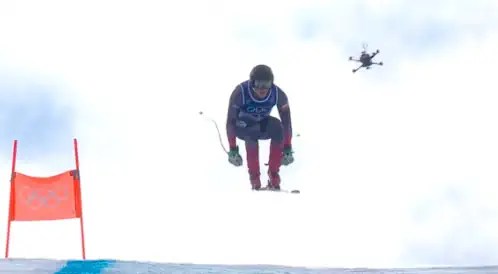
These aircraft are able to follow athletes from extremely close range, at extraordinary speeds, delivering live footage that places audiences directly inside the action.
During the Winter Games in Milan and Cortina, FPV drones are being deployed on a much larger scale for live broadcast than ever before. This is not an experiment on the fringes of coverage; it is a structural part of the production. For the drone industry, and for regulators watching closely, this moment matters.
From novelty to core broadcast tool
For the first time at an Olympic Winter Games, FPV drones are no longer used incidentally or sparingly. They are integrated into the broadcast setup as a core camera system, particularly for sports such as bobsleigh, skeleton, and luge disciplines where athletes exceed speeds of 100 km/h on narrow ice tracks.
In these environments, FPV drones offer capabilities that fixed cameras, cable cams, or cranes simply cannot replicate. They can accelerate alongside athletes, follow them dynamically through corners, and maintain a consistent visual perspective that conveys speed, risk, and precision in a way previously impossible. The result is not just more exciting footage, but a clearer understanding of the sport itself.
Responsibility for these shots lies with the Dutch media company Dutch Drone Gods, who provide both the pilots and the bespoke technology used during competition. Viewer reactions on social media platforms such as X suggest the impact has been immediate and overwhelmingly positive.
A drone built specifically for broadcast
Central to this success is a custom-developed FPV Broadcast Drone designed specifically for live television production. Compact, lightweight, and purpose-built, the platform weighs just 243 grams while being capable of speeds up to 100 km/h, with a flight time of approximately five minutes.
Crucially, this is not consumer technology repurposed for professional use. The drone integrates a high-end COFDM transmission system that connects directly into existing broadcast infrastructure. It supports native HD HDR video, both progressive and interlaced, and allows seamless integration into OB truck shading systems. For the complete RF chain, Dutch Drone Gods works in close cooperation with broadcast service provider Broadcast Rental, ensuring broadcast-grade reliability during live transmissions.
This level of technical integration demonstrates a maturity in the FPV sector that is often overlooked in public and regulatory discussions about drones.
Proven performance in extreme conditions
Although the drone’s origins lie in mountain bike coverage for UCI World Cup races, the design was extensively refined for the unique demands of the Winter Games. Operating above icy tracks, in cold temperatures, at extreme speeds, and within tight physical constraints requires exceptional stability and predictability.
According to FPV pilot ShaggyFPV, multiple specialist teams are operating across different winter sports, using drones ranging from 2.5 to 7 inches in size. Despite variations in airframes, almost all teams rely on the same transmitter and camera technology. In total, around 25 FPV drones are active during the Milan Cortina Winter Olympic Games for live coverage, a scale that would have been unthinkable only a few years ago.
Safety demonstrated on the world stage
Perhaps the most important takeaway for authorities and regulators is safety. The FPV Broadcast Drone’s low mass of 243 grams dramatically reduces risk to athletes, officials, and spectators. This stands in stark contrast to earlier incidents in the history of aerial broadcasting, such as the 2015 FIS World Cup slalom in Madonna di Campiglio, where a much heavier camera drone crashed and narrowly missed skier Marcel Hirscher.
At the Olympics, FPV drones are not only flying close to athletes, but doing so repeatedly, consistently, and under intense scrutiny, without incident. This is safety demonstrated at the highest possible level, in one of the most complex and high-profile sporting environments in the world.
A reference point for future permissions
The International Olympic Committee itself views FPV drones as more than a technical gimmick. Sports Director Pierre Ducrey has described their use as the next step in the evolution of sports broadcasting. The combination of speed, proximity, and smooth motion offers viewers a deeper understanding of what is happening on the track.
For aviation authorities and event regulators, the message is clear. The Winter Olympics should serve as a reference point for future sporting events, rather than an exception. When professional operators, purpose-built aircraft, and broadcast-grade systems are combined with structured risk management, FPV drones can be integrated safely and responsibly.
Making permissions easier for comparable events, under clearly defined conditions would not lower safety standards. On the contrary, it would encourage professionalism, transparency, and the use of proven technology rather than ad-hoc solutions.
FPV flying as a sport in its own right
There is also a strong argument that FPV drone flying at this level is a top-tier sport in itself. Pilots operate at the intersection of technology, precision, and timing, delivering live broadcasts under extreme pressure with no margin for error.
As ShaggyFPV put it on Instagram:
“Twelve months of preparation and this is the result. Without a doubt the most difficult job I’ve ever done: flying in such a tight space, fifty times per session, consistently, with no room for error. And now two more weeks to go.”
That statement encapsulates the professionalism now present in the FPV sector.
A win for viewers, sport, and the drone industry
The use of FPV drones at the Winter Olympics represents more than spectacular footage. It signals a turning point for how drones are perceived in high-risk, high-profile environments. Safety is not theoretical here, it is being proven live, to a global audience, every day of competition.
For the drone industry, this is a powerful validation moment. For authorities, it is an opportunity to recalibrate how permissions are approached for future events. And for viewers, it simply makes the Games more immersive, more understandable, and more exciting than ever before.
If drones can perform safely and reliably at the Olympic Winter Games, they can do so elsewhere, provided we allow the same level of professionalism and evidence-based regulation to guide the way forward.
Related
Discover more from sUAS News
Subscribe to get the latest posts sent to your email.