M-SAAVE Completes Humanitarian UAV Mission and Launches New Clean Air Initiative
M-SAAVE Completes Humanitarian UAV Mission and Launches New Clean Air Initiative

University of Michigan student team completes multi-year partnership
By: Lily Lewis
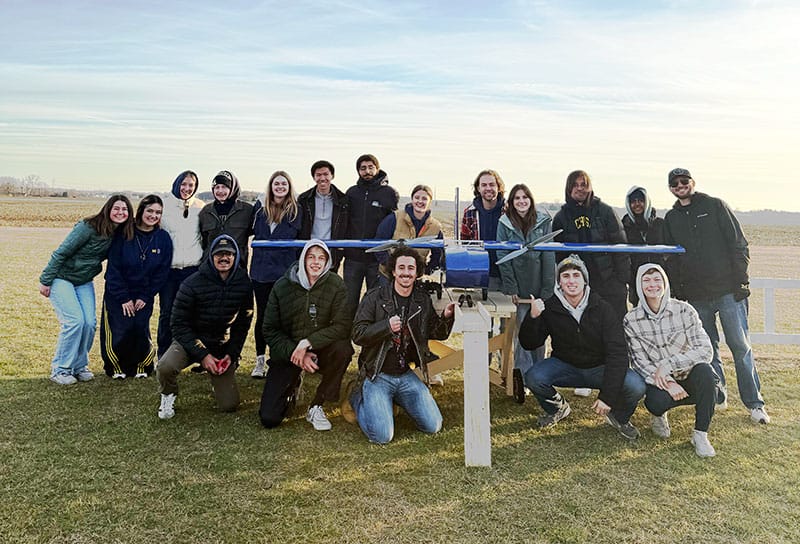
Over the past five years, students on the Michigan – Sustainability Applications for Aerospace Vehicle Engineering (M-SAAVE) student team have partnered with Air Serv International on a Humanitarian Unmanned Aerial Vehicle Mission (HUM).
The M-SAAVE team evolved from the University of Michigan Department of Aerospace Engineering’s x88 course series into a fully established, multidisciplinary student team dedicated to the humanitarian and sustainable applications of aerospace engineering. The team’s overall objective is to design, build, test, and fly an aircraft that is aligned with the United Nations Sustainable Development Goals (SDGs) while working with a partner organization on a core mission.
Based in Virginia and operating primarily in Sub-Saharan Africa, Air Serv International is one of the world’s leading aviation service providers for humanitarian aid using Cessna Caravan aircraft. Seeking new ways to supplement its fleet of single-engine turboprop utility planes, the organization contracted with M-SAAVE to search for an innovative, flexible solution.
The core goal of the partnership is to supplement the fleet of Cessna Caravans and create an aircraft with a modular payload that has the capability to deliver humanitarian aid via an airdrop payload configuration, equipped with RGB and infrared cameras to assess post-disaster damage and infrastructure needs.
Over years of design, iteration, and testing, the team ultimately completed the Humanitarian UAV Mission in December 2025 and demonstrated the full flight capabilities of their aircraft at the MRCA test field. During their test flight, the team did one basic take off, cruise, and land sequence before testing other, more advanced capabilities, including stalling the plane and recovering it, barrel rolls, and flying inverted to see how much their aircraft could handle. Experienced Michigan pilot and long-time supporter of U-M Aerospace Engineering project teams, Keith Shaw supported the effort, helping to guide multiple test flights and validate the aircraft’s readiness.

M-SAAVE team president Josh Zirin stated, “Keith was very helpful in the beginning of the project and also towards the end. He assisted the team last semester with their test flight and before flying the plane performed a mandatory in-lab inspection to ensure the plane is set up properly and that the configurations of the RC control are correct.”
Beyond flight demonstrations, the team produced comprehensive technical documentation outlining performance results, design decisions, and recommendations for future improvements. From there, the M-SAAVE students will deliver the compiled package of documentation to Air Serv International, ensuring the organization can build upon the students’ research and development.

Throughout the project’s lifetime, M-SAAVE has had to tackle multiple challenges related to its completion. This included students graduating and leaving the team, and also with certification and legal issues surrounding sending an aircraft to Africa.
At the same time, HUM’s success reflects M-SAAVE’s multidisciplinary strength. Students from majors across the University of Michigan – including aerospace engineering, mechanical engineering, computer science, and more – contributed to the finalization of the mission. Claire Wattenbach, the M-SAAVE lead of the systems subteam, explained that one of the great things about working on the M-SAAVE team was that it brought together multiple people from a variety of U-M departments and majors, providing different perspectives.
Meanwhile, Emmet Payette, co-leader of the structures sub-team, added, “It is very good professional experience doing a project team where you’re only a small section of it, compared to other academic projects, especially seeing the end of HUM, I felt that taught us a lot about what we need to do in the future and how integrating everyone more in the design process can avoid weird manufacturing problems at the end.”
What began as a classroom concept easily grew into a collaborative mission, focused on expanding access to life-saving aid in some of the world’s most remote regions. Now that HUM has been successfully completed, the team looks ahead to their next mission while taking lessons learned from this partnership to expand and shape their projects for the future.
What is next for M-SAAVE:
As HUM was coming to an end, the team began preparing for their next mission, the Clean Air Monitoring Mission (CLAMM), with a goal to aerially collect and analyze air quality data. Now in its early stages, CLAMM is focused on requirements development, preliminary design, and trade studies to evaluate sensor packages and aircraft integration strategies.
Zirin explained, “The reason that we settled on this was because, ultimately, M-SAAVE’s team charter and our goals are based around improving the human condition through applied aerospace applications, specifically focusing on the United Nation’s SDGs. One of those sustainment development goals is focused on sustainable cities and communities. So, we were trying to think of an application in which we could apply aerospace principles and help people out on a larger scale.”
Additionally, a subgroup of M-SAAVE students is collaborating with the Henry Ford Philanthropy Institute on a payload for the CLAMM mission through the institute’s annual Test Track Competition. The two-semester student competition guides teams through a six session empathy-driven design cycle challenge with opportunities for grant funding and continued mentorship from Ford professionals.
“It’s really a great way to get through a design cycle and get the prototyping, and potentially support at the end to implement the project,” commented Celia Radke, chief engineer of M-SAAVE. Through this, the team is working on a modular payload with a sensor package with the hope of integrating it into a plane or other vehicles.
Claire Wattenbach emphasised, “It is super cool to see the designs happening parallelly. M-SAAVE, the club itself, is really focused on technical design work while also having evolved the idea of CLAMM into even more of an empathy-based project.”
With CLAMM underway, M-SAAVE is building on the momentum of HUM to address a new challenge through data-driven aerospace design. As the team moves from concept to implementation, they remain committed to developing technologies that not only advance engineering innovation, but also serve communities in meaningful ways.
Payette highlighted that working with a variety of U-M students from across disciplines was key to HUM’s success. He stated, “Now is the perfect time to join the team because we are just starting a new mission, which makes it a great time to get involved.”
Wattenbach added, “We’ve learned a lot from our last mission and that is going to transfer into this next, even better mission over the next few semesters.”
Learn how to get involved in M-SAAVE and how to support the team’s efforts here.
Related
Discover more from sUAS News
Subscribe to get the latest posts sent to your email.
Other News in This Category
- Drone Delivery Is Expanding Quietly: And Most of the U.S. Hasn’t Noticed (Yet)
- 7 underrated drone YouTube channels you need to watch right now
- Persistent Flight in the Stratosphere – Justin Selfridge, Phd. and CEO of Devorto, on the Drone Radio Show!
- Counter-Drone Systems Begin to Shape Civil Airspace Rules