MiniV-Bat 234g, 74 minutes hover bicopter
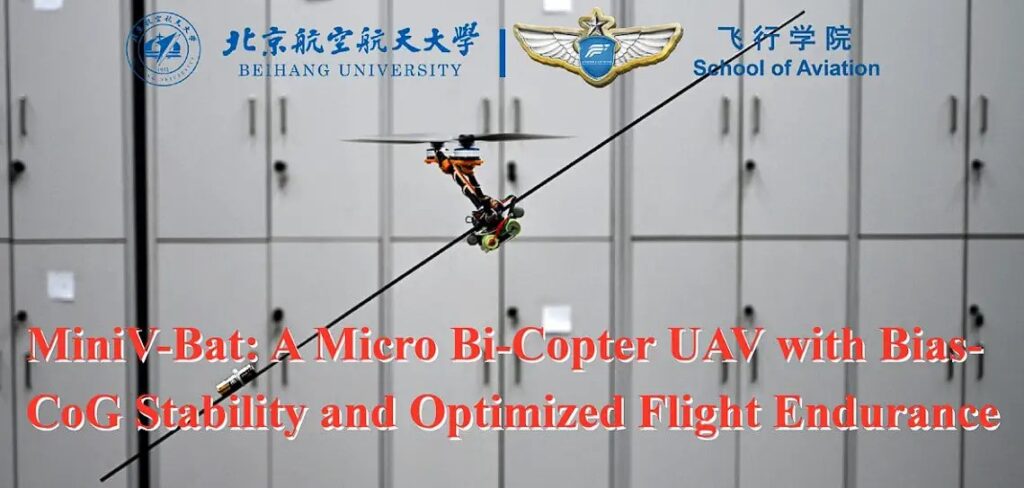
MiniV-Bat 234g, 74 minutes hover bicopter

Bicopters are theoretically the most efficient multi-rotor design for their size constraint, yet their real-world application has often fallen short.
This has really caught my attention on a Monday morning a 233.7g drone known as the MiniV-Bat. Designed by a team of researchers. Liu, Y. Bao, Y. Guo, Z. Wang, and X. He, this micro bicopter boasts a highly optimised hovering time of 74 minutes and extraordinary stability when handling large payloads and unknown shifts in its centre of gravity.
The researchers opine that historically, bicopters have faced two critical problems that prevented them from reaching their potential. The first is non-minimum phase dynamics: when you command a conventional bicopter to pitch forward, it actually tilts backward first due to servo reaction torque, which confuses the controller and causes oscillation. The second is centre of gravity (CoG) sensitivity, meaning any shifting payload makes the drone unstable and causes it to drift uncontrollably.

To solve this, the researchers noticed that no matter how much the vehicle’s body tilts due to CoG bias, the rotor disc stays perfectly level relative to the ground when hovering. This led to a new control method instead of controlling the vehicle’s attitude, they opted to control the rotor disc itself.
This simple change transforms the entire control problem. The researchers implemented a three-step rotor frame controller:
- First, they redefined the control feedback from the vehicle pitch angle to the rotor disc pitch angle, eliminating the problematic phase behaviour and making the system minimum phase.
- Second, they added a feedforward term that automatically compensates for CoG bias, ensuring the rotor stays level without any adaptation time.
- Finally, they transformed all angular rates to the rotor disc frame, eliminating the coupling effect between roll and yaw at large servo angles.
The MiniV-Bat, optimised for a maximum flight efficiency of over 14g per watt, achieves a 78% faster settling time compared to conventional controllers. It can comfortably handle a 100g off-centre payload that results in a body tilt of more than 45 degrees, and its convergence time when handling a sudden CoG shift is a mere 0.4 seconds. It also maintains stable flight under manual disturbances of up to 71 degrees per second.
I’m confident that this approach will not remain an isolated experiment. Controlling the rotor disc rather than the drone’s body is such an elegant and effective method that we are almost certain to see more of it in the future.
Some folks have different opinions, but this proves they might be coming.
Related
Discover more from sUAS News
Subscribe to get the latest posts sent to your email.
Other News in This Category
- FLUX GmbH Releases Whitepaper on Precision Position Feedback for Aiming and Tracking Systems in Defense Applications
- Online Oceans Raises £4 Million to Scale Autonomous Surface Fleets for Defence and Maritime Security
- Eurovision 2026 Opens With Europe’s Largest Drone Show
- Strong Partnership for Aviation: Knuerr, Voxtronic and IHSE present Integrated Control Room Solutions at Airspace World