Four Years That Changed Drones Forever
Four Years That Changed Drones Forever

Four years ago, the world crossed a line that cannot be uncrossed. When Russia launched its full-scale invasion of Ukraine, the geopolitical landscape shifted overnight, but so did something less obvious at the time: the future of drones.
Since that day, unmanned aviation has evolved faster than anyone in the industry could have predicted. What had largely been seen as a tool for photography, inspection, entertainment, and innovation suddenly became one of the defining technologies of modern conflict. The drone industry, regulators, military’s, and operators alike have been forced into a new reality, one shaped not by theory or speculation, but by real-world necessity.
A Personal Moment in a Global Turning Point
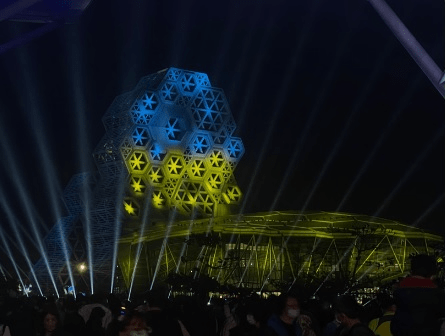
On the day the invasion began, Flyby Guys were thousands of kilometers away from Europe, operating drone shows in Taiwan during the Lantern Festival in Kaohsiung. It should have been a routine operation, a celebration of light, technology, and creativity. Instead, something strange happened.
Our radio frequency was jammed.
At first, it felt like a technical anomaly. Interference happens. Complex environments create unexpected challenges. But this was different. The disruption persisted, keeping us awake through the night troubleshooting systems until nearly 7 a.m. With global news unfolding in real time, it became impossible not to connect the dots. Geopolitics had entered our operational space.
In hindsight, it felt like a symbolic moment. While the world watched tanks roll across borders, even civilian drone operations thousands of kilometers away were feeling the ripple effects of rising tensions.
When roughly 1,500 drones abruptly left the show formation, it was alarming, but given the global climate at that moment, not entirely surprising.
That day marked a realization: drones were no longer isolated from global politics. They had
become part of it.
The War Few Expected to Last
Many analysts believed Ukraine would fall within days. Russian leadership appeared to expect a swift victory. Instead, four years later, after immense loss and staggering human cost, the war continues.
Ukraine’s resistance has rewritten assumptions about modern warfare, and drones sit at the centre of that transformation.
Ukraine entered the conflict with a strong aviation heritage and a technically skilled workforce. That foundation allowed rapid adaptation when traditional military advantages were limited. Rather than relying solely on conventional systems, Ukrainian forces embraced innovation at an unprecedented pace.
What followed was not just adoption of drone technology, but reinvention.
The Rise of FPV Warfare
Perhaps the most defining development has been the rise of FPV (First-Person View) drones. Originally associated with hobbyists and racing enthusiasts, FPV platforms were rapidly modified into highly effective tactical tools.
Garage workshops became innovation labs. Engineers, volunteers, and operators iterated designs in real time, adjusting hardware and software based on battlefield feedback. The speed of development was unlike traditional defence procurement cycles, which often take years or decades.
In Ukraine, innovation happened in weeks, sometimes days.
These adaptations created a new category of operational specialists. Drone pilots became as strategically important as traditional units, capable of delivering reconnaissance, precision targeting, and defensive capabilities at relatively low cost. The battlefield became more transparent, more dynamic, and far more technologically driven.
The implications extended far beyond Ukraine’s borders. Military’s around the world began reassessing doctrine, procurement priorities, and training models. Suddenly, small unmanned
systems were no longer supplementary assets; they were central to modern defence strategy.
NATO’s Strategic Awakening
As NATO countries supported Ukraine’s defence efforts, they were also learning. The war exposed gaps in preparedness and highlighted how rapidly warfare was evolving.
Traditional air superiority alone was no longer enough. Small, agile, and inexpensive drones proved capable of reshaping tactical outcomes. Nations that once viewed drones primarily as surveillance tools began investing heavily in autonomous systems, electronic warfare capabilities, and counter-drone technologies.
The lesson was clear: the future battlefield would be defined by adaptability. Ukraine’s experience forced defence planners to confront a difficult truth, innovation under pressure can outpace even the most advanced institutional systems. Real-world operational experience became the most valuable teacher.
The Emergence of Counter-Drone Warfare
The early phase of the war also revealed another critical dimension: counter-drone operations. Technology designed for safety and airspace awareness suddenly became controversial. DJI’s
AeroScope system, originally intended to help authorities identify drones and ensure
responsible operations, was reportedly used by Russian forces to locate both drones and their
operators.
The global drone community reacted strongly. Operators and industry professionals raised
concerns about how commercial technologies could be repurposed in conflict environments. The backlash ultimately contributed to AeroScope’s discontinuation and deactivation within the region.
This moment forced the industry to confront difficult ethical and technical questions. How should commercial drone infrastructure function during conflict? Where does responsibility lie when civilian technology is weaponized or exploited?
These questions remain unresolved, but they now shape product development, cybersecurity considerations, and policy discussions worldwide.
Where Are We Four Years Later?
Four years on, Ukraine continues to defend its sovereignty with ongoing support from NATO nations. Yet beyond the immediate military reality, something larger has taken place. Ukraine has become one of the world’s most advanced real-world laboratories for drone innovation.
The country’s engineers and operators have developed, tested, and refined systems under conditions no simulation could replicate. Successes and failures alike have accelerated learning at an extraordinary rate. While NATO countries invest heavily in future capabilities,
Ukraine has gained something impossible to manufacture artificially: battlefield-proven experience.
When the war eventually ends, hopefully sooner rather than later, the full scale of Ukraine’s technological achievements will likely reshape global aviation and defence industries.
This is not a story of NATO falling behind. Rather, it is a demonstration of how necessity drives innovation faster than bureaucracy ever can. Ukraine’s progress reflects urgency, adaptability, and a willingness to experiment under extreme pressure.
A Turning Point for the Entire Drone Industry
The impact extends well beyond military applications. Civilian drone operators now operate in a world where public perception has changed. Regulators, governments, and infrastructure operators increasingly view drones through a security lens.
This presents both challenges and opportunities.
On one hand, stricter regulation and heightened scrutiny have emerged. On the other, the proven effectiveness of drones has reinforced their importance across industries, from emergency response and infrastructure inspection to logistics and live broadcasting.
The technology itself is no longer questioned. Its value has been demonstrated beyond doubt.
The question now is how societies choose to integrate it responsibly.
Adaptation Is No Longer Optional
The past four years have shown that drones are not simply tools; they are catalysts for change. They have reshaped warfare, accelerated innovation cycles, and forced governments and industries to rethink long-held assumptions.
For operators, manufacturers, regulators, and defence planners alike, the lesson is unmistakable.
Adaptation is no longer a strategic advantage, it is a requirement.
The drone ecosystem that existed before 2022 is gone. In its place stands an industry defined by resilience, rapid innovation, and real-world validation. Whether in defence, commercial operations, or public safety, the trajectory is clear.
The future belongs to those willing to evolve.
Because in a world moving this fast, standing still is not an option.
Adapt, or be left behind.
Related
Discover more from sUAS News
Subscribe to get the latest posts sent to your email.