Iranian Arash 2
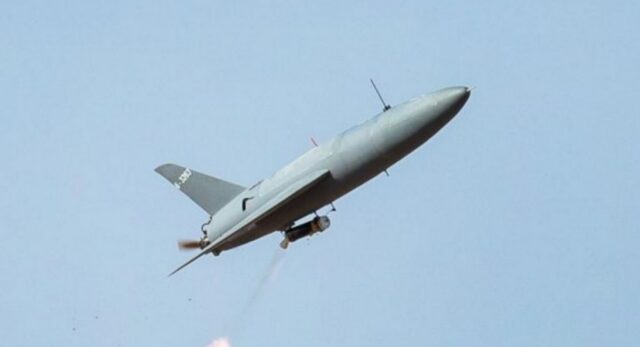
Iranian Arash 2

The Arash 2, an Iranian long-range one-way attack drone It is operated primarily by the ground forces of the Islamic Republic of Iran Army. Arash 2 is specifically designed for the suppression of enemy air defences and deep-penetration strikes. Its strategic value was brutally demonstrated on March 21 2026, when the Iranian military confirmed the use of the drones in a coordinated strike on military infrastructure and fuel depots at Israel’s Ben Gurion airport.
The origins of the Arash 2, which is also known as the Kian 2, lie in an earlier family of Iranian target drones. Its predecessors, the Kian 1 and the original Kian 2, were turbojet-powered aircraft introduced in 2014 and 2019 respectively.
Iranian engineers fundamentally redesigned the system, abandoning turbojet propulsion in favour of a highly efficient, rear-mounted piston engine that drives a pusher propeller. This shift sacrificed raw speed for extreme endurance, enabling the 4.5 metre (15ft) delta-wing drone to achieve a strike range of approximately 2,000km (1,240 miles) and remain airborne for up to 30 hours. Despite relying on a piston engine, the Arash 2 can still reach speeds of up to 480km/h.
The drone’s airframe is constructed using fibreglass composites and honeycomb structures, which serve to reduce its overall weight and minimise its radar cross-section. Crucially, the Arash 2 boasts a formidable payload capacity, carrying a 150kg high-explosive warhead designed to self-destruct on impact, with some configurations reportedly capable of carrying up to 260kg.
What sets the Arash 2 apart from cruder loitering munitions is its multi-mode guidance system. It is equipped with a passive radar homing head that allows it to autonomously detect, track and hunt down enemy radio frequency emissions. This creates a tactical dilemma for operators of advanced integrated air defence systems: activating a radar to intercept incoming threats turns the radar itself into a beacon for the Arash 2. If operators switch off their radars to evade detection, the drone seamlessly transitions to GPS, inertial navigation or an optical smart seeker to accurately dive onto the target.
The drone’s launch mechanisms further complicate defensive efforts. Accelerated by a solid-fuel rocket booster that is jettisoned shortly after takeoff, the Arash 2 can be deployed from disguised, truck-mounted containers. This containerisation allows mobile strike batteries to hide within civilian commercial traffic. The Iranian navy has also adapted the drone for maritime launch from the stealthy Shahid Soleimani-class corvettes and converted container ships like the IRIS Shahid Bagheri, providing the capacity to bypass land-based radar networks.
The Arash 2’s technology is actively proliferating. Since the start of the war in Ukraine, Russia has sought Iranian expertise, and recent reports suggest Russian forces have begun equipping their own Shahed-type drones with passive radar seekers derived from Iranian designs. In late March 2026, a passive radar homing unit purportedly recovered from a downed Russian drone—and featuring elements linked to Russia’s state radar identification network—was listed for sale on a Ukrainian military auction site. As a platform designed, built and operated by the conventional Artesh rather than the Revolutionary Guards, the Arash 2 signals a dangerous maturation in Iran’s military-industrial capabilities.
Related
Discover more from sUAS News
Subscribe to get the latest posts sent to your email.
Other News in This Category
- Inside the Future of Drones: Policy, Security with Michael Robbins, CEO and President of AUVSI on the Drone Radio Show
- AVSS collaborates with the Government of Canada through Innovative Solutions Canada to perform avalanche control work with drones
- 218 Wildfire Drone Incursions Last Year, Most Ever Recorded
- Singapore Bets on Drone Boxes for Island-Wide Public Safety