Sensor Integration Challenges in Multi-Layered Defense Architectures
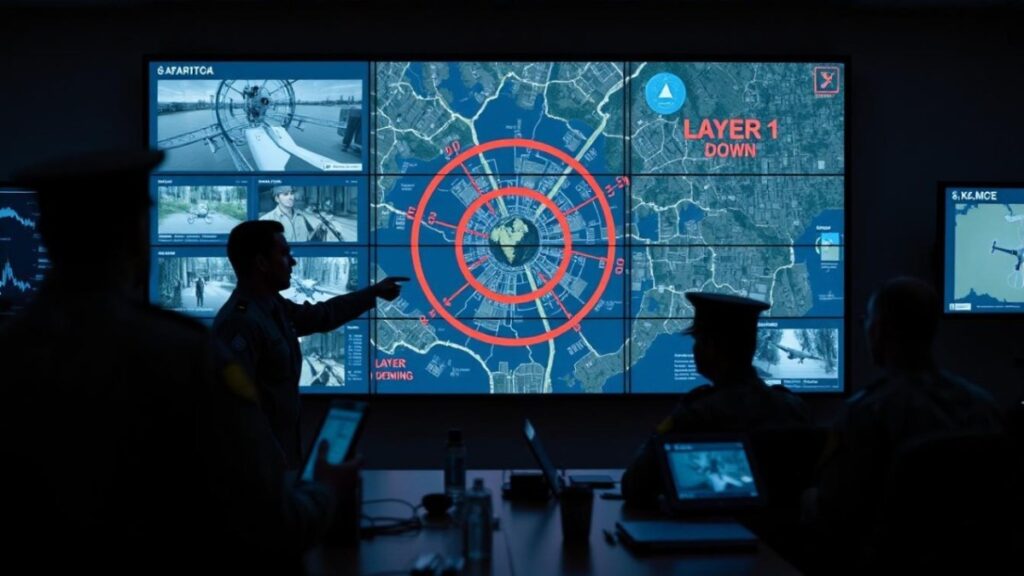
Sensor Integration Challenges in Multi-Layered Defense Architectures

Multi-layered defense architectures frequently create significant sensor integration and performance problems due to the layered structure itself. While the concept of “defense in depth” sounds intuitively appealing, after all, having multiple chances to stop a threat should be better than one, the reality is that the layering architect ure introduces fundamental inefficiencies that often make the overall system perform worse than a single, well-designed layer would.
Core Problem: Artificial Boundaries
The layering architecture creates artificial boundaries that:
- Introduce handoff latency at exactly the wrong time – Just when you need decisive action, the system is deciding which layer should act
- Fragment the engagement timeline – Instead of one continuous engagement process, you have discrete, disconnected phases
- Force suboptimal resource allocation – Resources are pre-assigned to layers rather than dynamically allocated to threats
- Accumulate rather than reduce uncertainty – Multiple independent tracking attempts add errors instead of reducing them
The fundamental issue is that layering creates organizational boundaries where none should exist from a physics or information theory perspective. The threat doesn’t know or care about your architectural layers; it simply follows a continuous trajectory. Your defense system, however, must now artificially partition this continuous problem into discrete chunks, and the interfaces between these chunks introduce friction, delay, and error.
Sensor Integration Challenges
Data Fusion Conflicts
Different layers typically use different sensor modalities, radar for long-range detection, electro-optical/infrared (EO/IR) for medium-range tracking, RF detectors for classification, and acoustic sensors for close-in detection. Each of these sensors operates with fundamentally incompatible characteristics:
- Refresh rates vary by orders of magnitude: A radar might update every 0.5 seconds, while an EO/IR camera runs at 30-60 Hz
- Coordinate systems differ: Radar works in polar coordinates (range, azimuth, elevation), cameras work in pixel coordinates, RF sensors provide bearing-only information
- Data formats are heterogeneous: Some sensors provide point tracks, others provide detection probabilities over regions, still others provide spectral signatures
The layering forces you to fuse data across these boundaries, creating:
Conflicting track IDs on the same target: Layer 1’s radar might assign Track ID #347 to a drone, while Layer 2’s EO/IR system calls the same drone Track #112. The system must now solve the “data association problem”, determining which tracks from different sensors correspond to the same physical object. This is computationally expensive and error-prone, especially when targets are close together.
Temporal misalignment: When a fast sensor (60 Hz camera) needs to correlate with a slow sensor (2 Hz radar), you must extrapolate or interpolate positions across time. During that interpolation period, the target has moved, and if it’s maneuvering, your extrapolation will be wrong. The layering architecture makes this problem worse because handoffs between layers occur at discrete moments determined by the architecture, not by optimal information flow.
Coordinate transformation errors during handoffs: Every time you convert from one coordinate system to another (radar polar → camera pixel → geographic lat/lon), you accumulate transformation errors. These errors compound because each layer’s sensor suite uses its own reference frame optimized for its sensing modality, not for system-wide tracking accuracy.
Ambiguity about which layer “owns” a track: When multiple layers detect the same target, there’s often confusion about which layer should be responsible for maintaining the track, deciding on engagement, or handing off to the next layer. This “ownership ambiguity” leads to either redundant processing (multiple layers tracking the same target independently) or dropped tracks (each layer assumes another layer is handling it).
Communication Bottlenecks

The nature of a layered system often creates bottlenecks that continue to worsen as information flow does not stop from sensors. Each layer needs to share threat data with other layers to enable coordinated response. However, this creates:
Bandwidth constraints: If Layer 1 detects 50 potential threats, it must transmit all 50 track files to Layer 2. Each track file contains position, velocity, classification confidence, threat assessment, etc. With limited bandwidth, this creates congestion exactly when you need fast information flow most, during a dense attack.
Latency degradation: The vertical information flow between layers is inherently slower than horizontal peer-to-peer communication. Information must traverse the full protocol stack, cross organizational/security boundaries, and often go through centralized command and control nodes. In a peer-to-peer architecture, nearby sensors could share tracks directly with microsecond latencies; in a layered architecture, the same information might take hundreds of milliseconds to traverse upward through layers, get processed, and flow back down.
Priority inversion: In a layered system, low-priority administrative traffic (status updates, health monitoring) often shares the same communication channels as high-priority threat tracks. The architecture doesn’t naturally enable dynamic prioritization because each layer has its own communication priorities that may not align with system-level threat priorities.
Geospatial Optimization Problems
Each layer’s sensors need to be positioned optimally for their specific mission, but these optimal positions often conflict: Adopting technologies that are much more forgiving or even take advantage of positions off the mark could alleviate some of these problems.
Example: Long-range radar placement that’s ideal for early warning (elevated position, clear horizon) may be terrible for cueing short-range effectors (which need sensors close to the defended asset). You can’t put the radar in both places, so you must compromise, and that compromise means neither layer performs optimally.
Coverage gaps: Layer 1 might have excellent coverage at high elevation angles (looking up at the sky), while Layer 3 needs excellent coverage at low elevation angles (near the horizon). Optimizing for one creates gaps in the other, and the layered architecture prevents dynamic sensor repositioning to fill these gaps based on real-time threat geometry.
Sensor masking: Layer 2’s effectors might physically block Layer 3’s sensors when they’re engaging targets, or Layer 1’s radar emissions might interfere with Layer 2’s RF-based classification. The layering doesn’t provide mechanisms to deconflict these physical and electromagnetic interference patterns.
Performance Degradation
Latency Accumulation
In a layered architecture, sensor data must propagate upward through layers for threat assessment and engagement decisions, then decisions must propagate back down for actual engagement. This bidirectional flow kills performance against fast-moving threats.
Look at the information flow:
- Layer 1 sensor detects → Layer 1 processor classifies → Layer 1 C2 decides → pass to Layer 2
- Layer 2 receives handoff → Layer 2 sensor confirms → Layer 2 processor classifies → Layer 2 C2 decides → pass to Layer 3 (if needed)
- Layer 3 receives handoff → Layer 3 sensor acquires → Layer 3 processor classifies → Layer 3 effector engages
Each arrow in this chain represents delay. Against a target moving at 50 m/s, just 10 seconds of accumulated latency means the target has traveled 500 meters closer, potentially moving through multiple engagement zones while the system is still deciding which layer should act.
The paradox: You built multiple layers to increase your chances of success, but the communication required to coordinate these layers means you’re taking action later than if you had a single layer with the same total sensing capability.
An Irony: A phrase sometimes used alongside multi-layered is graceful degradation, essentially the managed operations of a failing system so critical systems and services continue. Graceful degradation schemes in large layered defense systems can get into feed loops where multilayered defense increasingly fails as they lose capability and reach saturation. The degradation system tried to continue services by shutting off or redirecting power or bandwidth, further reducing defenses and so on. Much more modern approaches minimize layers and even integration in favor of a more organic approach where needs are met by social interactions with other systems.
Redundancy Without Benefit
Multiple layers often detect the same target, but the layered architecture prevents them from efficiently sharing that information, thereby reducing tracking accuracy.
Why this happens: Each layer’s tracking algorithms are optimized for that layer’s sensors and engagement envelope. Layer 1 tracks with coarse position but high confidence in velocity (radar Doppler). Layer 2 tracks with fine position but poor velocity estimation (EO/IR). Layer 3 tracks with very fine position but very short track history (close-range IR).
In an optimal system, you’d fuse all three into a single, more accurate track. But in a layered system, each layer maintains its own track because it needs independent engagement authority. The result is three parallel tracking processes consuming three times the computational resources, providing no improvement in track accuracy, and sometimes making it worse due to the sensor fusion conflicts described earlier.
Resource Contention
Layers compete for computational resources, communication bandwidth, electrical power, and even physical space on the deployment platform. The layered architecture pre-allocates these resources to layers based on anticipated threat scenarios rather than actual, real-time threat conditions.
The problem: When a saturating drone swarm attacks from one direction, you might want to allocate 90% of your computational resources to the layer best suited to handle that specific threat profile. Unfortunately, the layered architecture has already divided resources equally (or based on peacetime priorities), and there’s no mechanism to dynamically reallocate because each layer is designed as an independent system with fixed resource allocations.
Power budget example: Your platform has 10 kW available. Layer 1 radar uses 4 kW continuously. Layer 2 uses 3 kW. Layer 3 uses 3 kW. But what you really need right now is to run Layer 2 at maximum power (6 kW) because all threats are in Layer 2’s sweet spot. The architecture can’t support this reallocation without manual reconfiguration.
Mathematical Model: Contrived Example to Demonstrate the Point
Here’s a mathematical model that illustrates the fundamental problems with layered architectures. This is intentionally simplified to clearly show the core issues without getting lost in complexity.
Basic 3-Layer Defense Model
System Setup
Consider a 3-layer defense against incoming threats:
- Layer 1 (Long-range): Detection range R₁ = 10 km, engagement range E₁ = 8 km
- Layer 2 (Medium-range): Detection range R₂ = 5 km, engagement range E₂ = 3 km
- Layer 3 (Short-range): Detection range R₃ = 2 km, engagement range E₃ = 1 km
Target velocity: v = 50 m/s (typical small drone like a DJI Mavic 3 at cruise speed)
What this means: Each layer can detect threats at different ranges but can only engage within a smaller envelope. The gap between detection and engagement range represents the time available for classification, decision-making, and weapon preparation.
Latency Model
Total response time has cascading delays. For any given layer, the timeline looks like:
T_total = T_detect + T_classify + T_handoff + T_engage
Where for layer i:
- T_detect_i = sensor refresh period (e.g., 0.5s for radar to complete a scan) Why this matters: You can’t engage a target until your sensor completes a full refresh cycle to confirm it’s still there and hasn’t changed course
- T_classify_i = processing time (1-2s to run classification algorithms) Why this matters: You need to distinguish between a threat drone and a friendly helicopter/bird/balloon before engaging
- T_handoff_i = communication to next layer (0.5-1s for data transmission and acknowledgment) Why this matters: This is pure overhead introduced by the layered architecture,a single-layer system wouldn’t have this delay at all
- T_engage_i = weapon slew and fire (2-4s to point the effector and complete firing sequence) Why this matters: Physical systems have inertia; you can’t instantaneously repoint a jammer or kinetic weapon
Key Problem: In a layered system, if Layer 1 fails to engage (either because it missed, or because it chose to pass the target to Layer 2, or because the target was misclassified), the threat has already closed significant distance during Layer 1’s processing time. Layer 2 now has less time available than it would have had if it had been tracking from the beginning.
Engagement Window Calculation
The available time window for layer i to successfully engage a target is:
W_i = (R_i – E_i) / v – Σ(T_j) for all j < i
This formula captures the reality that each layer’s available time is reduced by all the time consumed by previous layers.
Example Calculation:
Layer 1 window: W₁ = (10,000m – 8,000m) / 50 m/s = 2,000m / 50 m/s = 40 seconds
Layer 1 has a generous 40 seconds from first detection to must-engage point.
Layer 2 window (if Layer 1 passed the target):
- Theoretical window: W₂ = (5,000m – 3,000m) / 50 m/s = 40 seconds
- But Layer 1 already consumed ~5 seconds (detect + classify + handoff decision)
- The target has traveled 5s × 50 m/s = 250m closer during Layer 1’s processing
- Actual available window: W₂ = 40s – 35s (time already elapsed) = 5 seconds
Layer 3 window (if both previous layers failed):
- Theoretical window: W₃ = (2,000m – 1,000m) / 50 m/s = 20 seconds
- But Layers 1 and 2 already consumed ~10 seconds total
- Actual available window: W₃ = 20s – 10s = 10 seconds (if you’re lucky and the handoffs were fast)
Critical insight: Notice that Layer 2’s actual engagement window (5 seconds) is 8x smaller than Layer 1’s window (40 seconds), even though both layers theoretically have the same 40-second window based on their detection-to-engagement range. The layering architecture ate 35 of those 40 seconds.
Kill Probability with Layering Overhead
For each layer, the probability of successfully engaging and destroying a target depends on having adequate time:
P_k_i = P_base × (W_i / W_ideal)
Where:
- P_base = inherent weapon effectiveness (~0.7-0.9, meaning the weapon works 70-90% of the time under ideal conditions)
- W_ideal = time needed for optimal engagement (~20s, allowing for sensor refinement, multiple engagement attempts if first shot misses, etc.)
- W_i = actual available engagement window (calculated above)
What this means: If you only have 5 seconds but need 20 seconds for optimal engagement, your kill probability is reduced by a factor of 4 (you’re 4x less likely to kill the target).
System kill probability (probability that at least one layer succeeds):
P_system = 1 – Π(1 – P_k_i)
This is the formula for “probability of at least one success” when you have multiple independent chances. It looks beneficial,multiple layers should increase overall success rate. But watch what happens when we plug in the compressed engagement windows…
Numerical Example:
Assume P_base = 0.8 and W_ideal = 20s
- Layer 1: P_k_1 = 0.8 × (40/20) = 0.8 × 2 = 1.0 (capped at 100%, this layer has plenty of time)
- Layer 2: P_k_2 = 0.8 × (5/20) = 0.8 × 0.25 = 0.2 (only 20% chance because window is so compressed)
- Layer 3: P_k_3 = 0.8 × (10/20) = 0.8 × 0.5 = 0.4 (40% chance)
Wait, but Layer 1 has 100% kill probability! So why do we need the other layers?
Layer 1 might choose not to engage for tactical reasons (conserve ammunition, target appears non-threatening, etc.), or Layer 1’s weapon might malfunction, or the target might employ countermeasures effective against Layer 1 specifically.
But here’s the problem: If Layer 1 chooses not to engage, Layers 2 and 3 are operating at severely degraded effectiveness (20% and 40% respectively) because Layer 1 consumed 5+ seconds making that decision.
The Problem Illustrated: Timeline Walkthrough
Scenario: Layer 1 detects at 10km, takes 4s to classify, 1s to make handoff decisiont=0s: Target at 10,000m, detected by Layer 1 radar[Layer 1 begins classification algorithms]t=4s: Classification complete: "Medium confidence - small drone"Target now at 10,000m - (4s × 50m/s) = 9,800m [Layer 1 command and control evaluates threat] t=5s: Handoff decision made: "Pass to Layer 2 for closer ID"Target at 9,800m - (1s × 50m/s) = 9,750m[Layer 1 transmits track data to Layer 2]t=6s: Layer 1 engages OR passes to Layer 2Target at 9,750m - (1s × 50m/s) = 9,700mIf Layer 1 passes to Layer 2:t=6s: Layer 2 receives handoff, begins processingTarget at 9,700m[Layer 2's EO/IR sensor slews to acquisition point]t=8s: Layer 2 classification complete: "High confidence - hostile drone"Target at 9,700m - (2s × 50m/s) = 9,600m [Layer 2 command and control evaluates engagement options] t=10s: Layer 2 engagement decision: "ENGAGE" Target at 9,600m - (2s × 50m/s) = 9,500m[Layer 2 effector begins slewing and firing sequence]13. t=14s: Layer 2 effector firesTarget at 9,500m - (4s × 50m/s) = 9,300mCritical issue: By the time Layer 2 gets the handoff at t=6s, the target is at 9,700m,already within what should be Layer 1’s engagement zone (E₁ = 8,000m). But Layer 1 has “given up” ownership and is no longer tracking this target as its responsibility. Meanwhile, the target is at 9.7km, well within Layer 1’s engagement range, but no one is shooting because Layer 2 is still setting up its engagement.
The handoff created a coverage gap where the target is in a zone where it could be engaged by Layer 1 but isn’t because Layer 1 has passed responsibility to Layer 2, which isn’t ready yet.
Sensor Fusion Conflict: Why More Sensors Can Make Tracking Worse
Intuitively, tracking a target with three independent sensors should give you a more accurate track than tracking wi th one sensor. But in a layered arcitecture, this often doesn’t happen.
If multiple layers track simultaneously (before handoff is complete), you must fuse their tracks. The fused position error is:
Error_fused = √(σ₁² + σ₂² + σ_handoff²)
Where:
- σ₁ = Layer 1 sensor error (inherent to the sensor)
- σ₂ = Layer 2 sensor error (inherent to the sensor)
- σ_handoff = coordinate transformation error introduced when converting between layers’ reference frames
Numerical Example:
For 3 layers, each with independent 10m sensor position errors:
- Single layer error: 10m (just use Layer 1’s track)
- Naively fused error (if we could perfectly fuse): √(10² + 10² + 10²) / 3 ≈ 5.8m (better!)
- Layered fusion error (including handoff transformation errors of ~5m per layer): Error = √(10² + 10² + 5²) = √(100 + 100 + 25) = √225 = 15.8m
The fusion made the track worse, not better! The coordination overhead of the layered architecture (coordinate transformations, time synchronization errors, different reference frames) added more error than the additional sensors reduced.
Why this matters: If your effector has a 20m kill radius, a 10m tracking error means 50% of your shots will be on-target. A 15.8m tracking error means only 35% of your shots will be on-target. The layering reduced your effectiveness.
It is important to note here that while the approaches described here are suboptimal, they are, of course, not the only ones. Militaries and the like tend not to like giving large numbers of agencies to those running the equipment. Unfortunately, with current ways of war, time is not only short; your opponent can adapt to your weaknesses, and you must be able to stop them before they can. While much of the systems the military procures from large companies are not designed to be as nimble and aware of the other assets that they work with, commercial C-UAS and air defense providers’ offerings are often just as bad or are marginal improvements. There is no reason why sensors should ever be in conflict, work at the maxim um, fuse or collaborate in local cells providing capabilities and services that are not seen in anyone’s sensor offerings, and it is not particularly hard. Making sensors perform in such a manner is occasionally easier and faster in developing the software to do it than traditional integration.
Resource Contention: The Overhead Tax
If computational resources C are divided among layers, each layer gets less than an equal share because coordination overhead consumes resources:
C_effective_i = (C_total / n) × (1 – overhead_i)
Where overhead_i increases with each additional layer because each layer must now coordinate with more other layers.
Numerical Example:
Assume total system compute is C_total = 100 GFLOPS (100 billion floating-point operations per second), divided among 3 layers.
With coordination overhead ~20-30% per layer (increasing as you go down because lower layers must monitor all upper layers):
- Layer 1: (100 / 3) × (1 – 0.20) = 33.3 × 0.8 = 26.4 GFLOPS (20% lost to coordination)
- Layer 2: (100 / 3) × (1 – 0.30) = 33.3 × 0.7 = 23.1 GFLOPS (30% lost to coordination)
- Layer 3: (100 / 3) × (1 – 0.40) = 33.3 × 0.6 = 19.8 GFLOPS (40% lost to coordination, must monitor Layers 1 AND 2)
Total effective compute: 26.4 + 23.1 + 19.8 = 69.3 GFLOPS
Lost to coordination overhead: 100 – 69.3 = 30.7 GFLOPS (30.7% of your total processing power is doing nothing but managing the interfaces between layers!)
Alternative architecture: A distributed, peer-to-peer architecture could allocate all 100 GFLOPS dynamically to the highest-priority threat without these structural inefficiencies. During a saturating attack, you could focus 90 GFLOPS on tracking and engaging the main threat, then reallocate to secondary threats once the main threat is neutralized.
Conclusion: The Layering Penalty
The mathematical model demonstrates that multi-layered architectures impose a systematic penalty on system performance:
- Time compression: Lower layers operate with drastically reduced engagement windows
- Error accumulation: Sensor fusion across layers adds error instead of reducing it
- Resource fragmentation: Coordination overhead can consume 30%+ of available processing power
- Coverage gaps: Handoff transitions create periods where targets are in-range but unengaged
These aren’t implementation bugs that can be fixed with better engineering; they’re fundamental consequences of the layered architecture itself. A distributed, peer-to-peer architecture could eliminate these penalties by allowing sensors and effectors to self-organize around threats without artificial layer boundaries. There are a number of organizations and companies that have been solving these problems for years, but it is very hard to change the current dogma. In the meantime, feel free to forward this on to your colleagues and coworkers to get their opinion. The only way to change the current paradigm is to get people the information and then hopefully testing and adoption follow.
References for Solutions and Alternative Architectures
1. Covariance Intersection for Decentralized Fusion
Julier, S.J. & Uhlmann, J.K. (2001). “General Decentralized Data Fusion With Covariance Intersection”
- Key point:: Foundational solution for distributed fusion when the correlation between sensors is unknown
- Key contribution: Provides consistent fusion estimates without requiring centralized coordination or knowledge of cross-correlations
- Application: Eliminates the need for layered architectures by allowing peer-to-peer sensor fusion
- Available: Chapter in Handbook of Multisensor Data Fusion (2nd Ed., CRC Press, 2008)
- https://www.taylorfrancis.com/chapters/edit/10.1201/9781420053098-19/
Related enhancement: Noack, B., Sijs, J., Reinhardt, M. & Hanebeck, U.D. (2017). “Decentralized data fusion with inverse covariance intersection,” Automatica, 79, 35-41
- Improves upon standard CI when some correlation structure is known
- https://www.sciencedirect.com/science/article/abs/pii/S0005109817300298
2. Peer-to-Peer Collaboration Framework
Lee, P., Jayasumana, A.P., Lim, S., & Chandrasekar, V. (2008). “A Peer-to-Peer Collaboration Framework for Multi-sensor Data Fusion”
- Key point: Demonstrates practical peer-to-peer architecture eliminating central fusion nodes
- Key contribution: Best Peer Selection (BPS) algorithm for dynamic peer selection based on computation/communication capabilities
- Application: Radar networks, distributed tracking systems
- Performance: Significant improvement in execution time vs. centralized approaches
- In: Emerging Trends in Engineering & Technology, Springer
- https://link.springer.com/chapter/10.1007/978-1-4020-8737-0_37
3. Distributed Service-Oriented Architecture for IoT
Fortino, G., Guerrieri, A., Russo, W., & Savaglio, C. (2014). “Distributed Service-Based Approach for Sensor Data Fusion in IoT Environments,” Sensors, 14(12)
- Key point:: Shows how to distribute fusion processing across nodes without centralized servers
- Key contribution: Service composition model where each device processes according to its computing capacity
- Application: Scalable to millions of devices; applicable to counter-UAS sensor networks
- Architecture: Lightweight middleware supporting heterogeneous devices
- https://pmc.ncbi.nlm.nih.gov/articles/PMC4239875/
4. Distributed Hidden Markov Model Architecture
Pham, C., Makhoul, A., Saadi, R., & Manirabona, A. (2019). “Distributed Fusion of Sensor Data in a Constrained Wireless Network,” Sensors, 19(5)
- Key point: Solves the communication bottleneck problem in distributed networks
- Key contribution: Conditional information exchange (likelihood ratios) instead of raw data transmission
- Performance: Maintains accuracy while reducing communication by 60-70%
- Application: Battery-powered sensor networks, UAV swarms
- https://www.mdpi.com/1424-8220/19/5/1006
5. DFuse: Dynamic Application-Specified Fusion
Kumar, R., Wolenetz, M., Agarwalla, B., Shin, J., Hutto, P., Paul, A., & Ramachandran, U. (2006). “DFuse: A Framework for Dynamic Data Fusion in Sensor Networks,” ACM Transactions on Sensor Networks, 2(3)
- Key point: Addresses the static allocation problem in layered systems
- Key contribution: Distributed role assignment algorithm that dynamically adapts fusion task placement
- Performance: Significantly increases network lifetime over static placement
- Application: Provides framework for Pattern Harvesting-style adaptive defense
- https://dl.acm.org/doi/10.1145/1167935.1167940
6. SwarmControl: Distributed UAV Network Architecture
Bertizzolo, L., D’Oro, S., Melodia, T., & Basagni, S. (2020). “SwarmControl: An Automated Distributed Control Framework for Self-Organizing Drone Networks,” IEEE INFOCOM
- Key point:: Demonstrates how to eliminate centralized control in UAV networks
- Key contribution: Decomposes centralized network control into distributed sub-problems with automatic algorithm generation
- Architecture: Hides low-level protocol stack details while enabling programmability
- Application: Infrastructure-independent drone swarms, distributed counter-UAS
- https://arxiv.org/pdf/2005.09781
7. Distributed Estimation Review (State of the Art)
Battistelli, G. & Chisci, L. (2019). “Distributed estimation over a low-cost sensor network: A Review of state-of-the-art,” Information Fusion, 54, 36-53
- Key point: Comprehensive review of distributed fusion techniques vs. centralized approaches
- Key contribution: Comparative analysis of consensus-based, diffusion-based, and hierarchical architectures
- Covers: Covariance intersection, information filter approaches, event-triggered methods
- Application: Provides roadmap for selecting appropriate distributed architecture
- https://www.sciencedirect.com/science/article/pii/S1566253518307747
8. UAV Swarm Communication Architectures Review
Bekmezci, İ., Sahingoz, O.K., & Temel, Ş. (2019). “UAV swarm communication and control architectures: a review,” Journal of Unmanned Vehicle Systems, 7(2), 93-113
- Key point: Comprehensive comparison of infrastructure-based vs. infrastructure-less architectures
- Key contribution: Analysis showing infrastructure-less (mesh) architectures provide better resilience
- Covers: Cellular, mesh, hybrid approaches; distributed decision-making
- Application: Shows why distributed architectures outperform layered for swarm defense
- https://cdnsciencepub.com/doi/10.1139/juvs-2018-0009
9. Collaborative Defense Architecture (Modern Implementation)
Aitech Systems (2025). “How Collaborative Defense Meets the Challenges of Drone Swarms”
- Key point: Current industry approach to solving multi-layer coordination problems
- Key contribution: Interoperable systems enabling distributed cooperative defense
- Architecture: Heterogeneous asset integration with real-time collaboration
- Addresses: Tempo mismatch (AI vs. human), EW resilience, cross-platform communication
- Application: Operational framework for implementing distributed counter-UAS
- https://aitechsystems.com/collaborative-defense/ (April 2025)
10. Chee-Yee Chong: Distributed Fusion Handbook
Hall, D., Chong, C-Y., Llinas, J., & Liggins, M. (Editors) (2012). Distributed Data Fusion for Network-Centric Operations, CRC Press
- Key point:: Most comprehensive treatment of distributed fusion architectures and algorithms
- Key chapters: “Decentralized Data Fusion: Formulation and Algorithms” (Thompson, Nettleton, Durrant-Whyte) “Distributed Estimation” (Chong, Chang, Mori) “Object Classification in a Distributed Environment” (Llinas & Chong)
- Covers: Track fusion, track association, consensus algorithms, service-oriented architectures
- Application: Complete theoretical and practical foundation for distributed defense systems
- https://www.routledge.com/Distributed-Data-Fusion-for-Network-Centric-Operations/Hall-Chong-Llinas-LigginsII/p/book/9781138073838
Bonus: Practical Implementation Example
TELEGRID AeroGRID+ – Drone Swarm Technology with MANET
- Implementation: Mobile Ad-hoc Network (MANET) with mesh radios for drone-to-drone communication
- Architecture: Distributed decision-making, hybrid publish-subscribe pattern
- Security: End-to-end encryption, authentication engine
- Application: Real-world example of Pattern Harvesting-style architecture (R. Sen, Cognoscenti Labs)
- https://telegrid.com/aerogrid (February 2022)
Important Themes Across These References:
- Covariance Intersection (CI) – Mathematical solution for fusion without known correlations
- Peer-to-Peer Networks – Eliminate central bottlenecks
- Service-Oriented Architecture (SOA) – Enable heterogeneous system integration
- Dynamic Resource Allocation – Adapt to real-time threat conditions
- Mesh/MANET Communications – Infrastructure-independent resilience
- Distributed Decision-Making – Remove single points of failure
- Event-Triggered Communication – Reduce bandwidth requirements
- Consensus Algorithms – Achieve coordination without centralization
These references provide both theoretical foundations (CI, distributed estimation theory) and practical implementations (SwarmControl, AeroGRID+, collaborative defense) for moving beyond traditional multi-layered architectures.
Related
Discover more from sUAS News
Subscribe to get the latest posts sent to your email.