DARPA / Flite Test – Lift Challenge updates
DARPA / Flite Test – Lift Challenge updates

This might be the most interesting drone competition since the Outback Challenge. I wouldn’t use a single airframe, have a look at the bottom for what I would do.
The US Defence Advanced Research Projects Agency (DARPA) has announced a competition offering $6.5 million (£5.1m) in prizes to innovators capable of fundamentally transforming heavy vertical lift aviation.
Known as the DARPA Lift Challenge, the contest is designed to “shatter the current paradigm” of vertical lift aircraft, seeking groundbreaking designs that dramatically improve the payload-to-weight ratio in multi-rotor drones. Current unmanned aircraft systems (UAS) often operate at a ratio of 1:1 or less, severely limiting their usability. The goal of the challenge is to spur designs that can carry payloads more than four times the aircraft’s own weight.
Phillip “Donna” Smith, the Program Manager for the challenge, described the competition as an effort to tap into America’s innovative spirit and drive down the cost per pound of transported cargo, opening up new efficiencies in sectors such as logistics, construction, and agriculture.
The Rules of Lift
The challenge places strict constraints on the aircraft itself while demanding immense lifting capability:
Aircraft Requirements
• Weight Limit: The aircraft, excluding the payload and all its components, must be a heavier-than-air drone and weigh less than 55 pounds (24.95 kg) at weigh-in. Lighter-than-air concepts or gases used to provide lift are strictly prohibited.
• Takeoff and Landing: The drone must achieve non-assisted vertical takeoff and landing (VTOL). Take-off or landing cannot involve sliding or rolling.
• Design Integrity: Teams are not allowed to add or subtract any parts or components (including energy sources) between the loaded and unloaded portions of the course; they must carry all elements, including payload attachments, during the unloaded return.
• Controllability: To demonstrate control, the centre body of the drone must land and take off within a 5-foot radius zone.
The Payload
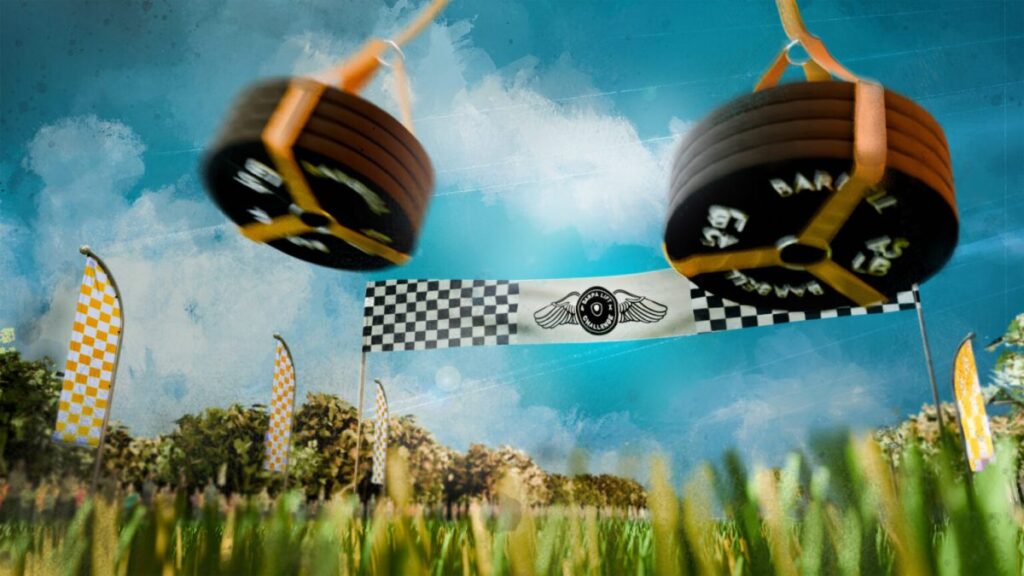
The payload consists exclusively of commercially available, standard cast iron Olympic barbell plates, which DARPA will provide for uniformity.
• Minimum Load: To post a qualifying run, the drone must carry a minimum payload of 110 lbs.
• Location: All plates must be “co-located at a single point” on the UAS; distributed payloads or using the weights for structural reinforcement are disallowed, reflecting the intent to transport consolidated cargo. A government-provided tracker, which counts towards the payload weight, will also be attached.
The Course
The competition tests not only lifting power but endurance and precision over a circuit-style five nautical mile course.
• Flight Path: The drone must fly four nautical miles carrying the payload, drop it off in a designated 5-foot radius zone, and then complete the final one nautical mile unloaded.
• Altitude and Time: The aircraft must maintain a flight altitude of 350 feet (+/- 50 ft). The entire course must be completed in under 30 minutes.
• Scoring: The ultimate winner is determined by the aircraft that achieves the highest payload-to-weight ratio.
Regulatory Hurdles and Participation
While DARPA has worked to lower barriers to entry to encourage broad participation, including garage inventors, the competition remains highly regulated due to the necessary operating weights.
To win prize money, teams must be US citizens or US-registered entities. Although the aircraft is designed to be under 55 lbs, carrying the minimum 110 lb payload means the drone will operate well above this limit. Therefore, competitors must secure an FAA Part 107 certification, experimental airworthiness, and a commercial drone license. Furthermore, to operate at maximum takeoff weight in the approved airspace, teams must obtain a specific FAA authority known as a 44807 summary grant.
DARPA is aiming for 200 to 300 teams at the final summer 2026 event, which may potentially be held alongside Flight Test’s flagship Flightfest event in Malvern, Ohio. Teams will receive two 90-minute flight windows to attempt to post their best score.
The challenge is seen as crucial for developing a strong understanding of the rules and regulations surrounding heavy drone operations, fostering a community empowered by shared knowledge. As Program Manager Smith noted, transforming aviation requires showing a “relevant payload weight that shows immediate impact to the user,” and this competition is designed to deliver precisely that.
This is how I would do it, almost like it was made for the task. Spread the risk, have redundancy for failure. At the Ardupilot conference in Yorkshire this presentation lit the room up. Come on Leonard, enter.
https://freespaceoperations.com.au/
Related
Discover more from sUAS News
Subscribe to get the latest posts sent to your email.
Other News in This Category
- Windracers selected as key supplier in UK Government’s biggest ever drone package for Ukraine
- Aerodyca – Chimango 650 UAV
- The Drone Workflow That Scales: Turning Flight Data Into Better Products
- FAA publishes FDC 6/2824, scrapping the ‘ICE NOTAM’ blanket drone ban and adopting ‘Department of War’ language