First conviction for flying drone over an emergency response
First conviction for flying drone over an emergency response

A man has been sentenced for multiple drone offences including flying over emergency services attending a major incident, believed to be the first conviction of its kind.
Christopher McEwen, aged 46 and of Crome Road, Norwich appeared at Norwich Magistrates Court today (Friday 13 February 2026) having pleaded guilty to 17 offences at an earlier hearing. These offences include flying a drone close to where an emergency response effort is ongoing, taking a photograph inside a prison, flying in a restricted zone, failing to keep unmanned flight in sight, failing to comply with maximum operating height. He was sentenced to pay a £2,000 fine, £800 victim surcharge and £110 in costs. He was also ordered to forfeit his drone for destruction.
The sentence follows a series of incidents over a six-month period between January and June 2025 when McEwen repeatedly breached various laws governing the safe use of drones. 44 flights were logged on his DJI Mavic 3 Pro Cine drone during this period.
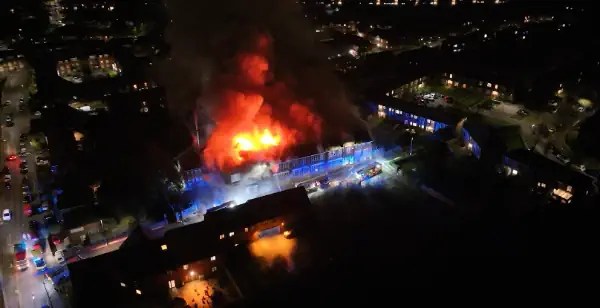
On the evening of 20 January 2025, there was a large industrial fire on Dibden Road, Norwich at a disused factory. Police, fire and ambulance were all in attendance with multiple resources working for a number of hours. During this time, McEwen chose to fly his drone three times, directly over the fire and in close proximity to the scene. Permission is required to fly over an emergency response due to dangers it can pose to those working underneath. McEwen failed to do this. An existing drone presence also prevents emergency services from using their own drones in the area, to assess and respond to an ongoing situation, inhibiting on their ability to do their jobs.
McEwen’s home address is within a Flight Restriction Zone, due to the close proximity to Norwich Airport which is where he regularly flew his drone. It is an offence to fly within a Flight Restriction Zone without permission from air traffic control at the airport, due to the dangers you could pose to other aircraft within the sky. 33 of the 44 flights recorded by McEwen were within these zones.
The maximum allowed height is 120m or 400 feet away from the closest point of the Earth’s surface. A warning of this height restriction is shown by the drone that McEwen had been flying yet he chose to entirely disregard this in 39 of the 44 flights. On 2 May 2025, McEwen flew his drone to around 1,900ft into the air. He came to within 350m of a light aircraft travelling over the south of Norwich and the pilot of the plane had no knowledge of the drone’s presence in the sky. This could have had catastrophic consequences should he have collided with the aircraft.
When flying a drone, you must always keep the drone within direct eyesight to ensure you can safely monitor its flight. McEwen admitted that he can only maintain proper sight of his drone to around 400m. 36 of the 44 flights reviewed for this case were flown to such distances that a visual line of sight would be physically impossible. During one of these flights, he flew 2,378m away from the take off point.
Throughout all of these flights, McEwen was required by law, due to the weight and capability of his drone, to be registered with the CAA as an ‘operator’. He had been previously registered but this had expired during the time of offending. He should have also completed a flying competency test for each drone category that he flew in. This would have been two categories which he failed to do. Both are offences under the Air Navigation Order 2016 and therefore all of his flights were then unlawful.
A further offence was recorded, outside of the six-month period, following a flight on 26 June 2024. During this flight, McEwen flew over HMP Norwich on Knox Road. He did not have permission to do this. During this flight, he took two images of prisoners outside in an exercise yard. This is a breach of Section 40D of the Prison Act 1952. The flight was also within a Flight Restriction Zone and exceeding the altitude limit.
Investigating officer, PC Jon Parker, from Norfolk Police’s Community Safety Operational Unit, said: “McEwen’s offending showed a blatant disregard for the rules and regulations imposed on those who want to fly a drone.
“These guidelines are in place to protect everyone’s safety and they must be respected. We appreciate many people will feel that these are minor offences however they can have devastating consequences.”
Richard Pace, managing director of Norwich Airport added: “While most drone operators act responsibly, this case is a timely reminder of the legal requirements for flying drones near airports. Norwich Airport’s Flight Restriction Zone extends two and a half nautical miles from the airport, and further from each end of the runway. Anyone wishing to fly a drone within these areas must obtain permission from air traffic control at the airport in advance. Full details are on the airport website. These restrictions are in place to protect aircraft and the people on board, as well as those on the ground.”
Alan Ward, East Anglian Air Ambulance Aviation Advisor, says, “East Anglian Air Ambulance provides critical care 24/7 by road and air across our region. The charity provides treatment and care to around 2,000 people a year. Drones are becoming increasingly commonplace for leisure purposes and in the workplace. While they offer incredible opportunities, we urge all drone operators to follow regulations and stay alert to the risks in order not to endanger lives.”
Alan continues, “A collision between a drone and an air ambulance, or any aircraft, could be catastrophic. Beyond this, a drone could cause a delay to critical care operations by prohibiting safe landings and take offs. Today’s verdict is a reminder of the risks and the legal responsibilities of drone operators.”
Related
Discover more from sUAS News
Subscribe to get the latest posts sent to your email.
Other News in This Category
- Picogrid Awarded Contract to Streamline XVIII Airborne Corps Battlefield Integration
- Donecle Raises €10 Million to Expand Drone-Based Aircraft Inspection Platform
- Is the U.S. Ready for Drone Threats at World Cup Scale?
- Pano Investigation: No Evidence of Russian Drones in Belgium Despite €50m Emergency Spend