UK Fliers, watch out, TSA’s about
UK Fliers, watch out, TSA’s about

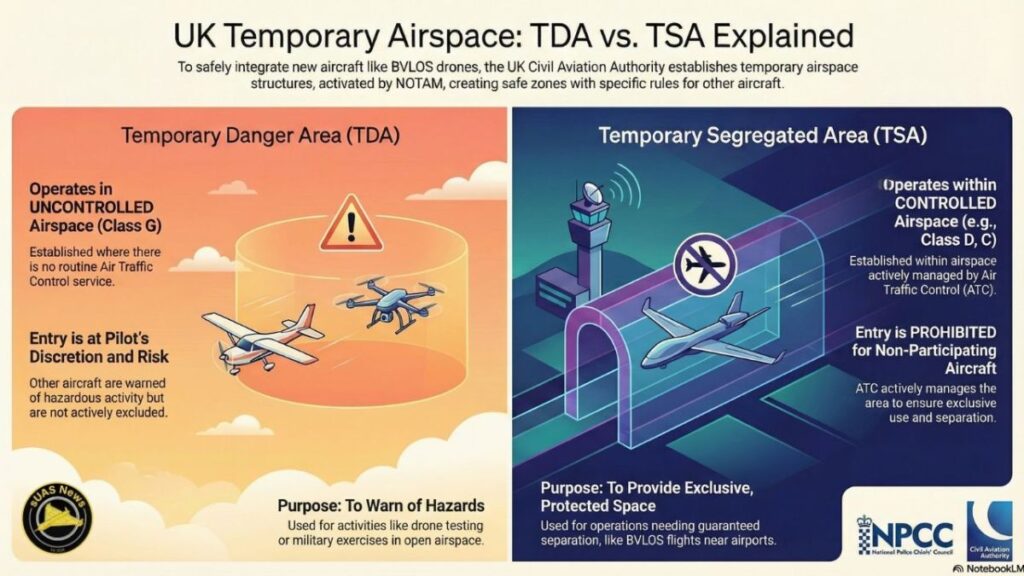
Greetings, navigators of the advanced skies. Temporary Danger Area (TDA) and the Temporary Segregated Area (TSA) time to understand the subtle yet crucial distinctions governing these temporary structures, both of which fall under the category of Special Use Airspace (SUA).
A TDA is defined as airspace where activities dangerous to the flight of aircraft may exist at specified times. Its primary policy function is hazard containment. These “hazardous activities” may not always be inherently dangerous but require a degree of segregation for safe undertaking. TDAs are frequently established within Class G (uncontrolled) airspace where Air Traffic Control (ATC) separation is not routinely provided.
The core distinction of a TDA is its conditional permeability. While unauthorized entry into an active Danger Area, including a TDA, is a serious infringement often prohibited by byelaws under the Military Lands Act 1892, pilots approaching an active TDA have the option to request an SUA Crossing Service (historically known as DACS) from the appropriate ATC unit.
If the controller determines that the hazardous activity can be safely managed or co-ordinated, a transit clearance may be granted. This flexibility means TDAs are focused on managing the risk of entry.
In sharp contrast, a TSA is fundamentally a mechanism of exclusive reservation, designed to provide absolute operational assurance for a specific user. A TSA is a defined volume of airspace temporarily segregated and allocated for the exclusive use of a particular user during a determined period of time, and crucial to this definition is the constraint that other traffic will not be allowed to transit.
This absolute impermeability is necessary for high-assurance operations, particularly Remotely Piloted Aircraft System (RPAS) BVLOS flights that lack full Detect and Avoid capability.
Look put for NOTAMs dear UK commercial drone reader new NOTAMs detailing the activation times and boundaries of TSAs supporting NPCC drone in a box deployments of DFR flights should be published with a minimum of 24 hours notice and should typically be provided before activity begins, unless otherwise approved by the CAA.
The reliance on the TSA mechanism, especially when used within Controlled Airspace (CAS) to provide “absolute exclusion” for new users like BVLOS drones, is going to cause a massive headache for the General Aviation (GA) community.
TSAs, by their very design, are impenetrable; unlike TDAs where a clearance can sometimes be requested through the former Danger Area Crossing Service (now SUA Crossing Service), a TSA simply says: keep out. When these segregated zones are placed inside busy low-level controlled airspace, as seen in the Aberdeen Control Zone example, they directly reduce the already scarce resource of accessible airspace. GA operates predominantly in uncontrolled Class G airspace, but frequently requires access to controlled zones for transit or operation around aerodromes. Losing blocks of controlled airspace entirely to absolute segregation is deeply restrictive.
It will be fun to observe the reaction from major GA representative bodies like Airspace4all, and the Aircraft Owners and Pilots Association (AOPA). These organisations consistently champion the principle that airspace regulations should be the minimum required to maintain safety and reflect the needs of all users on an equitable basis.
The absolute exclusion policy of the TSA directly undermines the concept of accommodating all users, forcing crewed aircraft onto potentially less efficient routes. I foresee significant political and regulatory trouble ahead as the CAA attempts to balance the commercial imperative of drone integration with the established, historic access rights of GA pilots.
The TSA creation necessary for scaling NPCC and DFR operations might just trigger a major airspace access conflict.
Commercial operators in the UK seem to being dealt a difficult hand by trials of DFR equipment that seem to operate above the law (see what I did there)
Related
Discover more from sUAS News
Subscribe to get the latest posts sent to your email.